
Property Investment Stockport: Why We Invest In The North West

Every January the property press runs the same article with a different cover.
"The 10 UK Cities to Watch." Spread your bets. Diversify across the regions. London is making a comeback. Look at Sunderland. Look at the Tees Valley. Look, frankly, anywhere except where you are.
I've read these for a decade and they share one fatal flaw: they confuse optionality with strategy. Knowing about ten markets is not the same as being able to operate in any of them. A Rightmove yield map is not a power team. A regen press release is not a builder you can ring at 7am.
I haven't bought a property outside Greater Manchester since 2019. The next one will be in the same patch — almost certainly in Stockport. Here's the data behind that, the regen pipeline most people aren't reading properly, and the deals from my own portfolio that prove the case isn't theory.
Buckle in. This is going to be more 'spreadsheet' than 'holiday brochure'.
1) The Macro Backdrop: Why The Cycle Now Favours Regional Value-Add
Let's get the rates conversation out of the way first.
The Bank of England held Bank Rate at 3.75% on 30 April 2026 in an 8–1 vote, with one MPC member arguing for a hike. The next decision lands on 18 June. (Bank of England) UK CPI inflation reaccelerated to 3.3% in the year to March 2026 — services inflation is still running at 4.3% — and the Bank itself flagged that CPI is likely to print between 3% and 3.5% through Q2 and Q3. (ONS, March 2026)
Mortgage rates have followed the choppiness. Moneyfacts data showed the average 2-year fixed buy-to-let rate moving from 4.66% on 1 March to 5.44% on 1 April 2026, with the average 5-year fixed BTL rising from 5.05% to 5.75% over the same window. (Moneyfacts via Mortgage Finance Gazette)

This is the part where most "where to invest" articles fall apart. They look at the macro and conclude: hold off, wait for cuts, wait for inflation, wait for the next budget. That's how you spend a decade waiting.
The honest read of this cycle is the opposite. With inflation sticky and rates structurally higher than the post-2008 hangover, the deals that survive are the ones where the operator creates the value — refurb, refinance, regear, raise rent through quality, not capital growth alone. That's value-add. That's regional. That's exactly the work Stockport rewards.
Drilling for oil where you live, not where the brochure says.
Speaking of oil, if you want to read my take on the US-Iran War and how it impacts your UK portfolio click here...
The US–Iran War: Why UK Property Still Wins
2) The HPI Story: Where Capital Is Quietly Compounding
"Manchester's already had its run."
Sound familiar? Half-true, but i'm a 'glass half full' kinda guy.
Nationwide's April 2026 HPI puts the average UK house price at £278,889, with annual UK growth of 3%. Within that headline, the regional split is the story. The North West printed +3.1% year-on-year in April, second only to the North East at +3.2%. (Nationwide HPI) Roll back to the Q1 2026 release and the North West was the top-performing region in England at +3.3% YoY, ahead of every Southern region by a comfortable margin. (Nationwide Q1 2026)
Every UK city tracked at over 3% annual growth in April sits in the North of England — Burnley, Blackburn, Rochdale, Liverpool, Barnsley. London, the South East and the East are flat or close to it. The "regional outperformance" pattern that lazy commentary still treats as a forecast has been the actual data for several quarters.
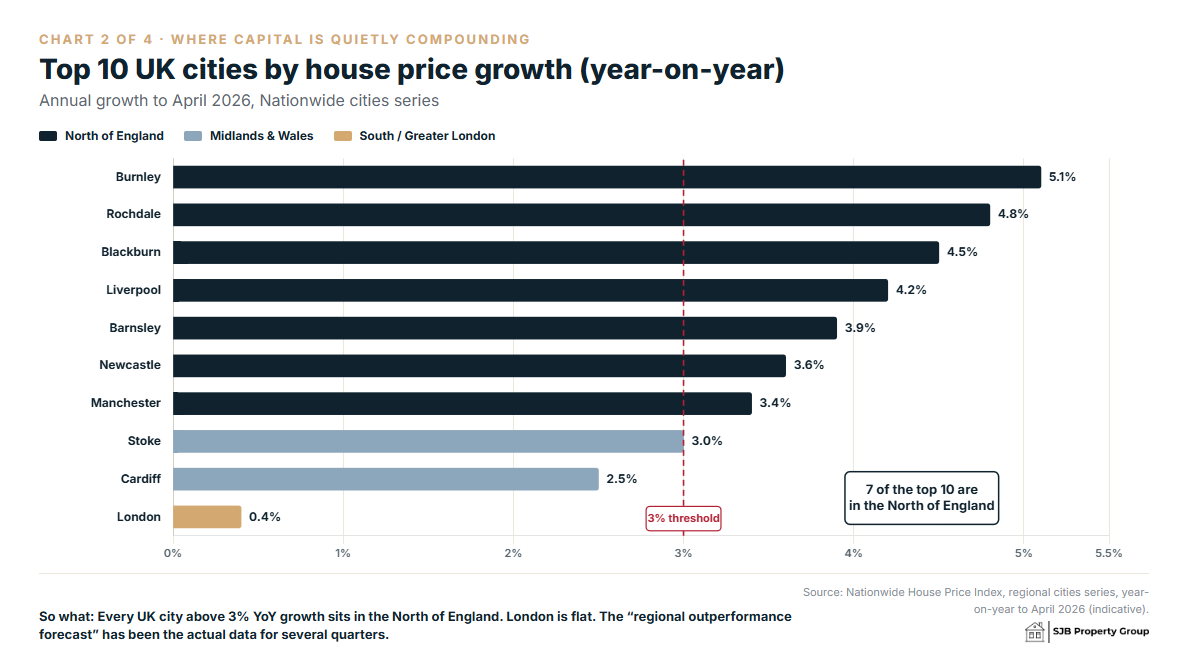
This isn't a one-print fluke. It's the same divergence Hamptons, Zoopla and Savills have been describing since 2024 — the pricier you are relative to local incomes, the slower you compound. North West stock is still trading at roughly half the average London price, against rents that have grown as fast if not faster.
Translation: COMPOUND is happening up here. Down south, capital is sitting in traffic.
3) Greater Manchester: The Structural Case
If the HPI is the symptom, the city-region engine is the cause.
Greater Manchester is the largest UK city-region economy outside London — £100 billion gross value added (GVA) across the ten boroughs, and the fastest-growing sub-regional economy in the country between 2015 and 2023, expanding at 3.1% per year against a UK average of 1.5%. The Greater Manchester Combined Authority (GMCA) projects the economy could be 36% larger by 2035 if that pace holds — another £38bn of GVA on top of the existing £100bn. (GMCA / IFS economic growth paper)
The population side compounds the same way. Greater Manchester is approaching three million people in 2026 and growing at roughly 0.7% annually. (GMCA) Five universities. Roughly 120,000 students inside the city-region. About half of those graduates stay after they finish their degree. That isn't a market — it's a tenant factory with a 50% retention rate.
Wait. There's more! MediaCityUK at Salford Quays. The Oxford Road corridor. Manchester Airport's continued expansion. The Bee Network finally bringing buses, trams and rail under a single Transport for Greater Manchester (TfGM) operator. Whichever sector you index — life sciences, advanced manufacturing, creative — the workforce is being built here while London quietly bleeds graduates into Berlin and Lisbon.
This is the bit your mate who watched a YouTube video about "the next big city" never models. The Greater Manchester case isn't a story. It's a thirty-year snowball effect, rippling outwards as we speak
All together now, "Manchester La, La, La..."
Stockport is one part of the rest that's getting it next.
4) Stockport Zoom: The £1bn Regeneration Map
"Stockport? Isn't that just where the viaduct is?"
Yes. And in two years it will be where some of the most-watched town centre regen in the country is.
The Stockport Mayoral Development Corporation (MDC) is a partnership between the GMCA, Stockport Council and Homes England, set up to deliver a £1bn town centre transformation. As of 2026 it has already attracted £600 million of private investment and delivered 1,200 new homes plus 170,000 square feet of Grade A office space. (Stockport MDC) On 23 February 2026, Parliament approved an expansion of the MDC boundary, formally re-designating it as the Stockport Town Centre MDC and roughly doubling the area in scope. (Stockport Council)
In March, Mayor Andy Burnham announced an additional £56.3 million allocation to Stockport from the GMCA's initial £400m investment pot — £41.3m fast-tracking the Stockport 8 sustainable neighbourhood and £15m unlocking 245 homes on a derelict office and car park site at Fletcher Street. (Stockport Council) That sits on top of public investment already in motion through earlier rounds.
Walk the town and you can see it landing. The new Stockport Interchange is open — bus, rail, residential and a two-acre rooftop park stitched together at the southern gateway to the centre. (Stockport Council) Capital&Centric's Weir Mill — 253 apartments inside a restored mill complex — completes this spring. (Stockport Council) Stockroom is live in Merseyway, anchoring the cultural offer with a new library and creative learning space. Stockport 8, a £350m scheme of 1,300 energy-efficient homes (435 in the first phase, 82 affordable), got planning green light and starts on site in 2026, completing in 2028 with the next phase from 2029. (Stockport Council).
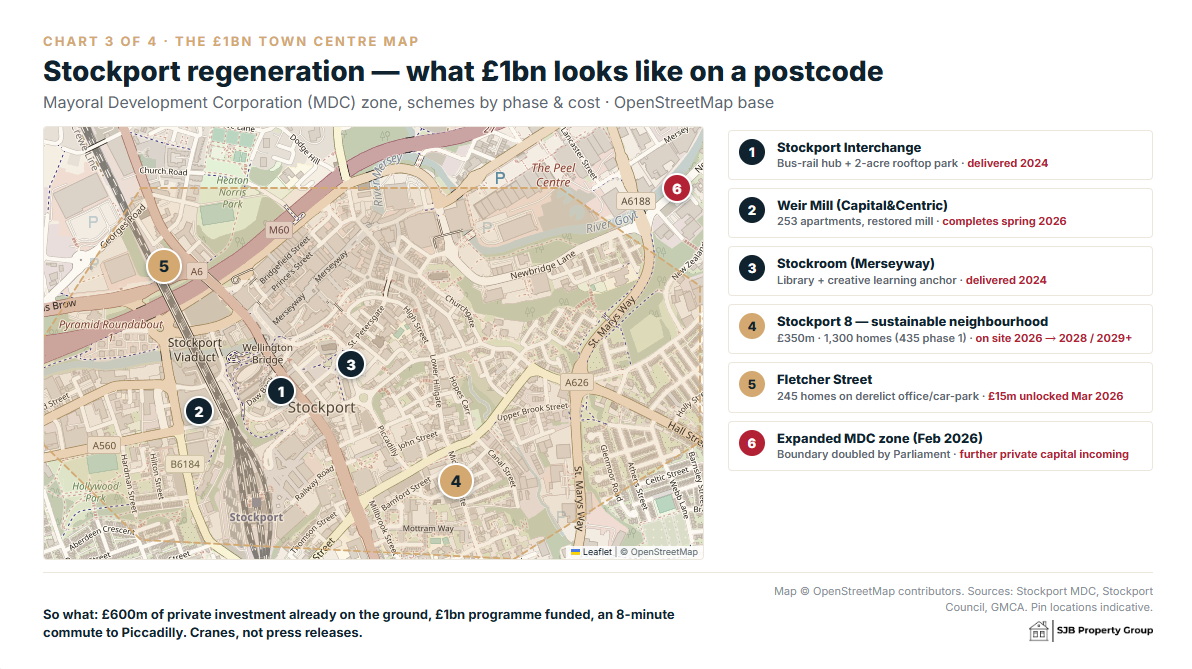
This is what £1bn of public-and-private capital actually looks like on a postcode. Not a press release. Cranes. Big ones. Always a sure fire sign that good things are on the way!
The bit the property press still hasn't fully priced in: it's eight minutes by train to Manchester Piccadilly. Eight. The Coronation Street viaduct commute is shorter than most people's school run.
5) The Future Pipeline: 2026–2030 At A Glance
Here's the build-out window most BTL forecasts ignore. Not "what might happen". What's funded, planned and consented.
- 2026 — Weir Mill (253 apartments) completes. Stockport 8 phase 1 starts on site. Fletcher Street scheme (245 homes) unlocked by GMCA funding. Expanded MDC boundary now operational, drawing further private capital into the wider town centre footprint.
- 2027 — Continued delivery across the MDC pipeline; ongoing private-sector development on consented sites. Bee Network expansion continues integrating bus/rail/tram across Greater Manchester under TfGM.
- 2028 — Stockport 8 phase 1 (435 homes, including 82 affordable rent) completes. Cumulative MDC delivery moves materially through the £1bn investment plan.
- 2029–2030 — Stockport 8 phase 2 commences. Further sites unlocked under the expanded MDC. Energy Performance Certificate (EPC) C deadline for the Private Rented Sector (PRS) lands on 1 October 2030 — accelerating retrofit and refurb demand across older stock.
The right way to read that list isn't "new flats coming, oversupply risk." It's "a town that already has decent fundamentals is having a billion pounds of public-and-private capital, plus a major transport rewire, pointed at it for the next decade." Public investment of that scale tends to lift the whole rental and sales market around it, not just the new-build stock inside the MDC fence. That's what regen actually does, and the data from already-delivered phases bears it out.
A Stockport street that the market currently treats as ordinary terraced stock will, in five years, be a five-minute walk from a transformed town centre and a brand-new sustainable neighbourhood. The maths on that uplift isn't subtle.
All together now..." I O County, County I O"
6) Yields & Rental Demand: What Landlords Actually Earn Here
Now the bit that pays the mortgage.
Paragon Bank's 2026 data has the North West achieving the highest average buy-to-let yield of any English region at 7.84%, well ahead of London (often sub-5%) and the South East. (Paragon Property) Inside that, Greater Manchester routinely produces yields between 6% and 8% for single-lets and comfortably above that for well-run small HMOs, like we run. Specific Manchester postcodes (M14 and similar) are doing 7.9%+.
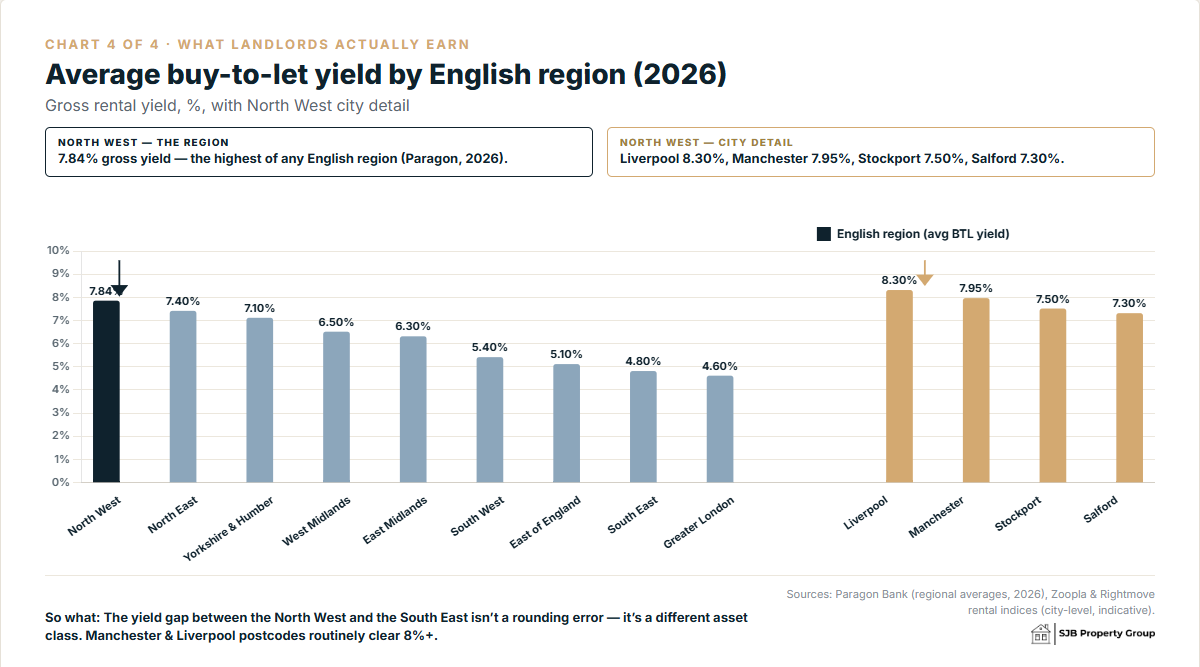
Translate that into operator language. A typical sub-£250k Stockport terrace, refurbed properly, lets at £1,100–£1,500/month depending on spec — broadly 7–8% gross before any HMO uplift. A small HMO done to professional-tenant spec (not the cram-and-rent model that's dragged the category's name through the mud) routinely clears £2,000–£3,000/month on the same purchase footprint. The yield gap to the South East isn't a rounding error — it's a different asset class.
Demand is the partner story. The Bee Network's reach, the regen narrative, the sticky graduate pipeline and the post-Renters' Rights Act tightening of supply (more landlords selling than buying since autumn 2025) have left every Stockport agent I deal with with active applicants on every property they list. That's not a forecast. That's last week's WhatsApp.
A Place in the Sun makes great Tuesday-afternoon telly. The North West makes the rent.
7) How SJB Property Group Plays It — The Actual Portfolio
I get to make this case because I've been making it with my own money since 2019, not just a Substack newsletter.
Project Moston was the first one. £100k cash purchase, £20k refurb, refinanced at £180k post-works. Capital left in the deal: £0. Rent: £900/month. ROI: infinite, in the literal sense. Where the snowball started, and why I won't stop banging on about capital recycling.
Project Vienna on Vienna Road. £166k cash purchase, £40k refurb — full structural reconfiguration, two chimney breasts and a structural wall removed, kitchen-diner created, six-month job. Refinanced at £176k. Rents at £1,300/month, generates ~£536/month net, 16.68% ROI. The JV investor who funded the cash purchase was repaid in full with an 8% fixed return. Everyone went home happy. (PLUG ALERT.)
Project Gradwell on the other end of the borough took a tired 2-bed terrace, converted it to a fully compliant 4-bed HMO (cellar to studio, full M&E upgrade, the works), and let every room within two days of marketing. 32% ROI. That isn't because we're geniuses — yes I'm aware that sounds smug — it's because the demand is that deep when the product is right.
Seven properties. ~£1.735m portfolio value. ~£100,800 gross rent. All of it inside Greater Manchester, most of it weighted to Stockport. None of it bought on a Phil & Kirstie episode.
8) Built By Landlords, For Landlords
Here's the honest pitch.
I'm not a fund manager pricing a deck from a Mayfair desk. I'm a landlord who lives in this market every day — my team and I run the same systems on our own portfolio that we'd run on yours. The reason we invest in Greater Manchester ourselves and the reason we manage property in Greater Manchester for other landlords is the same reason: the maths is here, the operators are here, and the borough rewards people who stay deep instead of going wide. (It rhymed, dont judge)
Built by landlords, for landlords. That isn't a slogan we bolted on for the website. It's the only way this works at scale — the property management arm exists because we needed it for our own homes first, then formalised it.
If you've got capital sitting in a savings account losing to services inflation, you'll want how we invest in Greater Manchester — that's the JV and fixed-return side. Minimums apply. Real reporting, real properties, real numbers, no projections that need a magnifying glass.
If you've already got property up here (or anywhere in Greater Manchester) and you're tired of doing the boring infrastructure yourself, you'll want our full property management service. Full management 10% of rent collected, tenant-find only 65% of the first month's rent, refurb project management 15% of build cost. Or, if you want it modelled honestly against what you currently earn, book a no-obligation portfolio review and we'll cost it together. If the numbers don't work for you, we'll tell you. Better to know now.
Either way - The case is: a borough with a £1bn regeneration plan, the highest regional rental yields in England, the best HPI growth in the UK in Q1, and a price point still inside our underwriting band — operated by a team that's been here professionaly and diligently here for seven years — beats any "next big city" article you'll read this year.
I am, predictably, biased. IT'S WHERE I OPERATE. But the maths is the maths, and the maths is in Stockport.
The Takeaway
- Stop hunting for the next big city. Start running deep in one you can actually OPERATE.
- Stop reading regen press releases. Start reading planning portals, MDC documents and council licensing pages.
- Stop chasing yield maps. Start building (or hiring) a power team that can execute on every postcode within twenty miles of your laptop.
- Stop spreading bets across the country. Start CONCENTRATING on the borough you'd happily pop down to on a Tuesday morning to look at a wonky flat roof.
- Stop confusing optionality with strategy. A spreadsheet of ten cities you don't operate in is not a portfolio. It's homework.
FAQs
1. Why is the North West outperforming the rest of the UK property market in 2026? Three reasons stack: affordability headroom (North West stock trades at roughly half average London prices), the strongest regional rental yields in England at an average of 7.84% (Paragon Bank), and a city-region economy growing at double the UK rate over the last decade. Nationwide HPI placed the North West at +3.1% YoY in April 2026, second only to the North East. (Nationwide HPI · Paragon)
2. Why Stockport specifically rather than central Manchester? Pricing and pipeline. Stockport terraces still trade in a sub-£260k window where buy-to-let and small HMO underwriting works on current mortgage rates, while a £1bn Mayoral Development Corporation programme is delivering 1,200+ new homes, 170,000 sq ft of office space, and a transformed transport interchange — eight minutes by train from Manchester Piccadilly. Central Manchester is a great market; Stockport is the one with regen dollars still arriving. (Stockport MDC)
3. What is the Stockport Mayoral Development Corporation (MDC)? The Stockport MDC is a partnership between the Greater Manchester Combined Authority (GMCA), Stockport Council and Homes England, formed to deliver a £1bn town centre regeneration programme. Parliament approved an expansion of its boundary on 23 February 2026, roughly doubling the area in scope. To date the MDC has attracted £600m in private investment and delivered 1,200 new homes and 170,000 sq ft of Grade A office. (Stockport Council)
4. What yields can I realistically expect on a Stockport buy-to-let? Single-let terraces in the Stockport postcodes we operate in typically yield 6–8% gross on purchase price, depending on refurb spec and rent achieved. Small HMOs to professional-tenant spec frequently exceed 9–10% gross. These are pre-finance, pre-tax figures — net cashflow depends on your mortgage product, your management model and your void assumption. Always model deals net, not gross.
5. Do you only manage properties for clients you've sourced? No. We manage properties for landlords who already own in Greater Manchester (Stockport-heavy) regardless of how the property was originally bought. Full management is 10% of rent collected, tenant-find only is 65% of the first month's rent, refurb project management is 15% of build cost. Book a no-obligation portfolio review and we'll model it against your current arrangement.
Right, that's the case. Now if you don't mind, I've got a viewing to organise in SK4 — the agent already thinks I'm late, the builder already thinks the kitchen's bigger than it is, and the mortgage broker is on the other line.
Yours, Sam Bradbury SJB Property Group