
US-IRAN WAR 2026: Why UK Property Investment Still Wins
"Oil's gone mental — pause everything until this blows over." "There's a war on, you'd be mad to invest." "Right, that's it, I'm going to cash in."
I've heard all three this week alone. From people I respect, from a JV partner mid-sandwich, and once — and I am not making this up — from a chap on the school WhatsApp who I'm fairly sure thinks Brent crude is a 'Strictly Come Dancing' contestant.
I get it. Tankers in the Strait of Hormuz, a UK CPI print that won't sit down, mortgage rates climbing while the Bank of England sits on its hands. Watch the news on a Sunday night and "do nothing" feels like the only sensible play.
It isn't.
Most landlords and would-be investors are watching the news and freezing. The operator's view is different. There's a chain — a TRANSMISSION mechanism — running from a tanker outside Bandar Abbas to your remortgage offer in Stockport. Once you can see the chain, you stop reacting to the headline and start positioning for the next link.
Which is exactly what we've been doing. We're still acquiring. We're still raising. And in this post I'll show you, link by link, why.
1. What's actually happening (the bit you can't doom-scroll your way out of)
Quick, neutral, factual — because I, a property operator, am not a foreign-policy commentator and you should be deeply suspicious of any property guru who suddenly is.
Tensions between the United States and Iran escalated through April 2026. Strikes and counter-strikes around the Strait of Hormuz disrupted commercial shipping through the world's most important oil chokepoint. A ceasefire was announced on 8 April. It has held — fragility intact — though subsequent attacks (May 4th 2026) on UAE infrastructure make the average mortgage broker reach for a coffee.
The market reaction is what matters here. Brent crude touched roughly $126/bbl in late April, settled near $114 on 4 May after fresh UAE attacks, and pulled back to around $110 once the ceasefire was reaffirmed. The International Energy Agency has called it the largest supply disruption in the history of the global oil market — and ship traffic through the Strait remains well below pre-war levels even with the ceasefire technically in place.
That's the macro environment we're underwriting in. Volatile, unresolved, and unlikely to be neatly tied off in an habitual, off-the-wall, Doanld J. Trump press release.
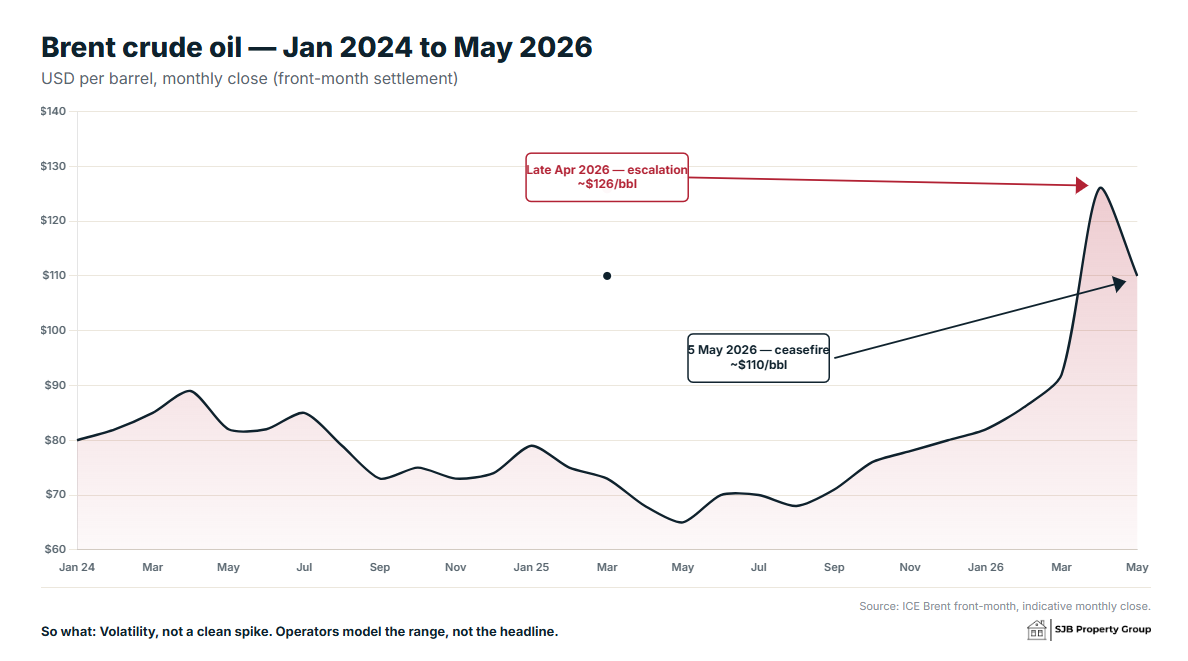
I'm not going to pretend I know how it ends. Anyone who does is selling something — and it usually isn't property.
2. The transmission chain — Strait of Hormuz to your remortgage bill
"Oil's a global thing — what's it got to do with my Stockport semi-detached?"
Everything. Sit tight, because this is the bit most people skip and then regret.
Here's the chain in five links:
Link 1: Brent crude → UK headline CPI. Energy is a direct input into transport, food, manufacturing and household bills. The ONS reweighted the basket in January 2026: housing and utilities gained 10.70 parts per thousand, while natural and town gas weight fell by 2.04 ppt as wholesale gas prices unwound from prior peaks. What does that actually mean? Energy still moves the index — just through a slightly different door than two years ago. And oil pass-through into UK CPI runs on a 3–6 month lag, which is why headlines don't show up at the petrol pump tomorrow but do show up at the supermarket in autumn.
Link 2: CPI → Bank of England policy stance. The latest CPI print was 3.3% YoY in March 2026, with CPIH services running at 4.3% — sticky, awkward, well above the 2% target. The Monetary Policy Committee held Bank Rate at 3.75% on 30 April 2026, with an 8–1 vote. The next decision lands 18 June 2026. Translation: the rate-cut path the market was pricing in January has been delayed, possibly cancelled, possibly reversed.
Link 3: BoE expectations → swap rates. Lenders don't price your fix off the headline Bank Rate. They price it off the 2-year and 5-year SONIA Overnight Index Swap (OIS) curves — what the wholesale market thinks Bank Rate will average over the life of your mortgage. The Bank of England publishes those curves daily. When oil spikes and rate-cut expectations get yanked, swap rates climb before the BoE moves a finger.
Link 4: Swaps → BTL mortgage pricing. Moneyfacts data tracks the average 2-year fixed BTL mortgage rising from 4.66% to 5.44%, and the 5-year from 5.05% to 5.75%, between March and April 2026. That isn't the BoE doing anything. That is the swap curve doing the work.
Link 5: Mortgage pricing → refinance pain → forced sellers → opportunities. This is the link nobody likes saying out loud. When the BTL landlord who fixed at 2.1% in 2021 comes off product in 2026 and gets re-quoted at 5.75%, their cashflow disappears. Some absorb it. Some sell. The ones who sell with a deadline are the deals operators with capital and systems are looking at right now.
Read that chain twice. It's not theory. It's the chest x-ray of the UK property market in May 2026, and once you can read the film you stop panicking and start working.
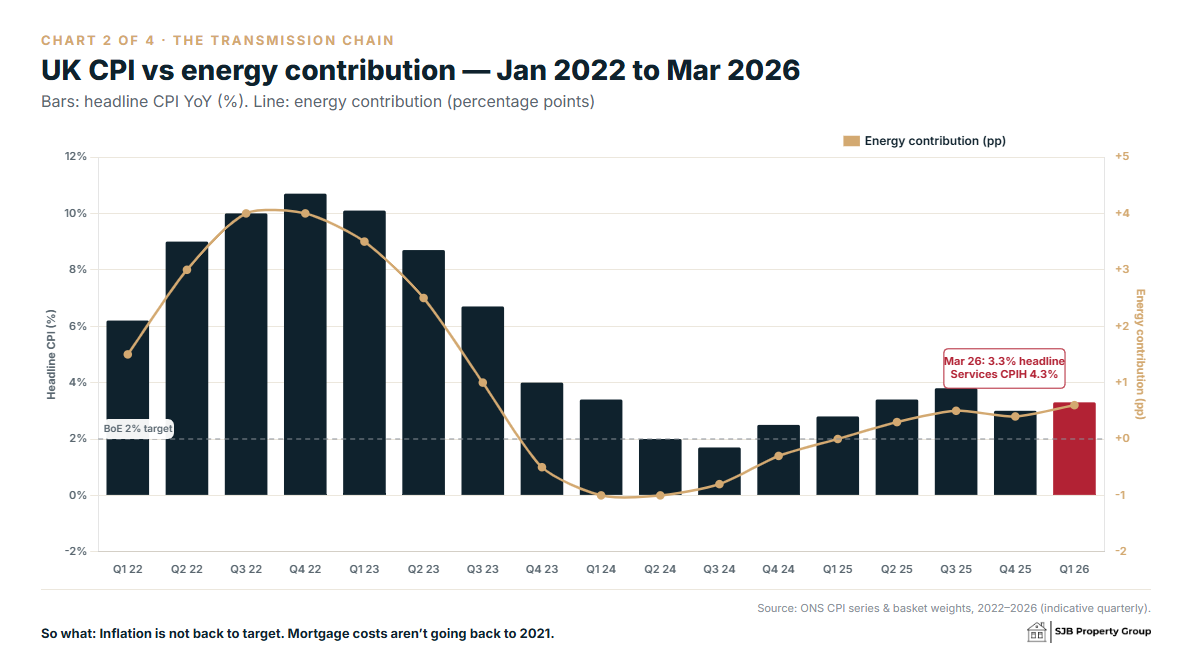 UK CPI YoY (bars) vs energy contribution in percentage points (line). Energy still moves the index — just through a slightly different door than two years ago. Source: ONS CPI series and basket weights.
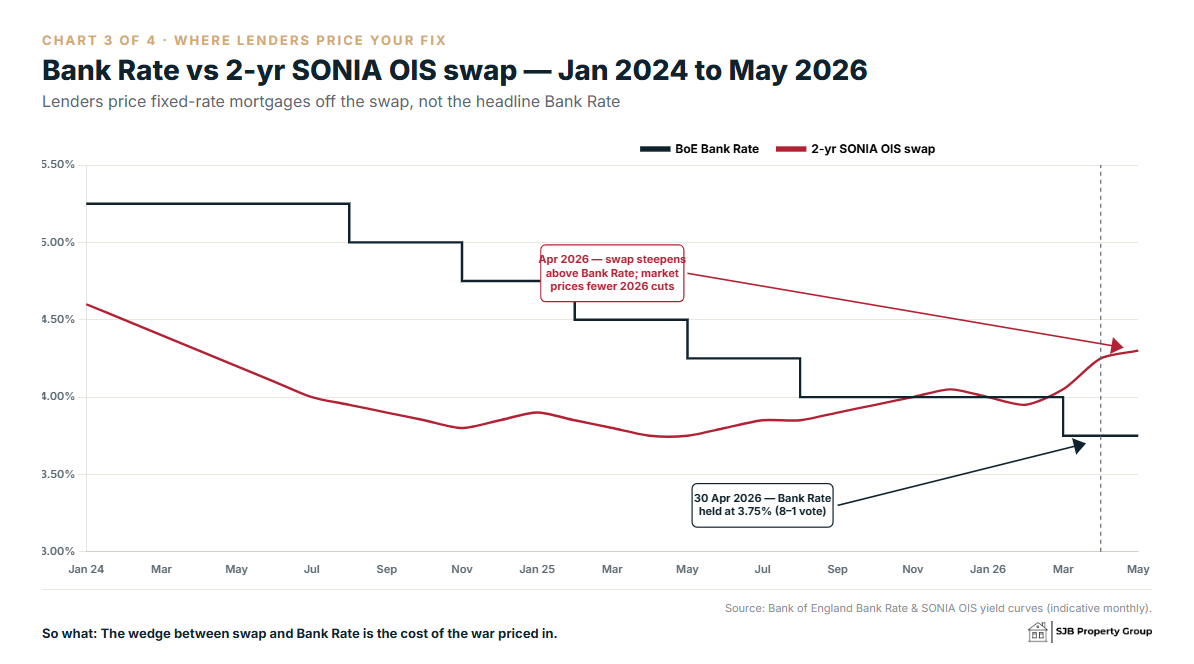 Bank Rate (stepped) vs 2-year SONIA OIS swap. Lenders price your fix off the swap, not the headline Bank Rate. The wedge between the two is the cost of the war priced in. Source: Bank of England yield curves.
3. The data right now (because vibes don't pay bills)
Five numbers I keep on a Post-It on the desk:
- CPI: 3.3% YoY, services 4.3% — sticky.
- Bank Rate: 3.75% — held, next move 18 June.
- Average 2-yr BTL fix: 5.44%; 5-yr 5.75% — climbing.
- UK average house price: £278,889.
- North West HPI: +3.1% YoY in April 2026, second only to Northern Ireland; Q1 2026 the top-performing English region at +3.3%.
And one more you don't see quoted enough: ONS Average Weekly Earnings is running ~5.6% nominal regular pay growth. Real wages are positive. Tenants can pay slightly more rent without their household budgets falling apart. That matters more than any oil chart.
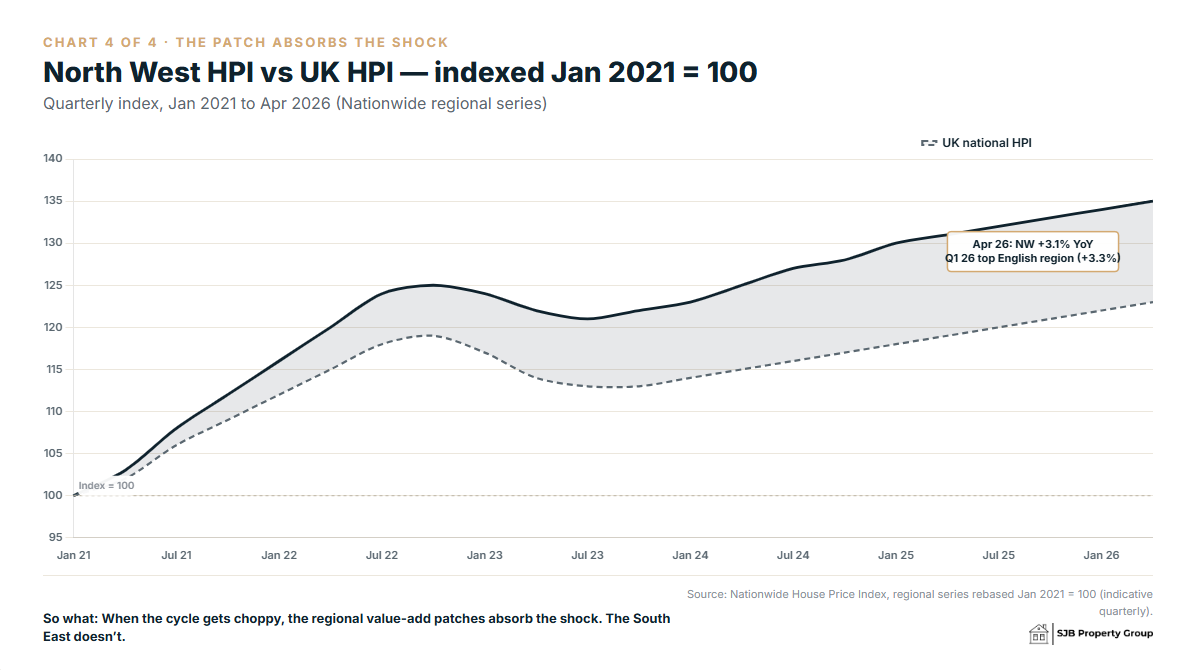 Nationwide HPI, NW vs UK, rebased Jan 2021 = 100. The North West has been the structural outperformer through the rate cycle and is doing so again in 2026. Source: Nationwide House Price Index regional series.
The composite picture: inflation is not back at target, money is more expensive than the 2021 cohort underwrote, and yet regional values are still grinding upward in the parts of England with real demand fundamentals. That's not a market that's broken. That's a market that's separating the operators from the tourists.
4. What this actually does to your BTL mortgage
Time for the slightly grim arithmetic.
Take a £150,000 BTL loan, interest-only, on a 5-year fix.
At the 2021 rate (~2.10%), monthly interest is £262.50. At the April 2026 average 5-year fix (5.75%), monthly interest is £718.75.
That is £456.25 a month — £5,475 a year — of cashflow vapourised before the boiler even breaks. Have I mentioned we offer Property Management Services?
Multiply that across a four-property portfolio and you'll see why the English Private Landlord Survey shows 31% of landlords planning to reduce portfolios and 16% intending to sell within two years. It's also why self-managing landlords are quietly tapping out — and why the ones who remain are increasingly picky about the patch, the yield and the operator standing behind the door.
If your loan-to-value is 75% and your gross yield is 5%, you're underwater on this maths in the South East. If your gross yield is 7.84% — the Paragon-published North West average — you're still in profit, just less of it.
I have a new blog coming 'Why we Invest in the North West' for a deeper dive...so stay tuned!
5. Why property still wins (and the one honest counter-argument)
"Surely there's something 'clevererer' than property in 2026? Stocks, gold, crypto, a bond ladder?"
Maybe in your portfolio mix, sure. But for a private investor underwriting a 5–10 year horizon with leverage and a need to outpace inflation, UK residential property still does something almost no other asset class does:
It reprices rent with inflation, while leaving your debt fixed in nominal terms.
That's the "borrowing in falling money" argument, and it's not new. The MSCI UK Quarterly Property Index has long-run total returns running ahead of CPI; UK direct property delivered 7.6% total return in 2024. You owe £150k today; in nominal terms in 2031 you still owe close to £150k. But the rent the property is producing in 2031 will be priced at 2031 prices. That gap is your inflation hedge, doing its job quietly while everyone is staring at oil charts.
Layer on the regional value-add piece. The North West averages 7.84% gross BTL yield. The South East doesn't. When swap rates wobble, the patch with the highest gross yield absorbs the shock first and recovers the fastest. We've covered this in detail in why I put every pound into the North West (NEW BLOG COMING SOON)— the short version is: yield is the airbag.
And the cycle entry point is the bit nobody is loud about. Refinance pain creates motivated sellers. Greater Manchester GVA is £100bn, the largest UK city-region economy outside London, with population on track for 3 million by mid-2026 and growth running at double the UK rate. Demand fundamentals don't move with oil. They move with jobs, transport, planning approvals and net migration into the patch. None of those have stopped.
Now the honest counter-argument, because I'm not going to pretend property is a free lunch.
Property is illiquid. Property is leveraged — which cuts both ways. Property is rate-sensitive on refinance. You only win if you have (a) operational competence, (b) capital reserves to ride out shocks, and (c) the right patch. If you're missing any one of those, all the inflation-hedge maths in the world will not save you.
That's not a sales pitch. That's the disclosure most property gurus skip and then turn up on a podcast looking surprised when half their clients fold.
6. Why we're still acquiring and still raising
This is where most "should I invest?" posts go silent and pivot to a newsletter signup. Not here.
We're still buying. Five reasons, no fluff:
- We underwrite to today's swap curve, not 2021's. Every deal sheet we model assumes the 5-year fix sits where it sits — 5.75%-ish — and the deal must clear that hurdle with a margin. If a deal only works when swaps are at 4%, it isn't a deal. It's a hope.
- We focus on Greater Manchester, with a Stockport bias. That's the patch where the £1bn Mayoral Development Corporation regen is actually being delivered, and where gross yields cushion rate moves. NEW BLOG COMING SOON: why I put every pound into the North West.
- JV partners get fixed-return contracts that price in current risk — 8–12.5% per annum, contractually fixed in writing for the term of the deal, secured against the property. These are contractual fixed returns, not investment "guarantees" in the regulated sense — and we're explicit with every investor about what that means.
- Track record stands up to a chest x-ray. Four investors. 100% repayment record. Seven properties across Greater Manchester (5 BTL, 2 HMO). Project Moston ran £0 capital in, infinite ROI on refinance. Project Gradwell is our highest-rent HMO at £3,750/month gross. Project Vienna delivered so that our investors and my own captial is refreshed and ready to go again...(seems like a good time to plug our investor guarenteed returns)
- We manage what we own. That sounds boring. It isn't. It's the difference between a portfolio that crumbles in a stressed market and one that compounds through it. Backstory in our other blog property management Stockport and why guaranteed rent isn't dead.
This is what an F1 pit crew looks like in property. The driver doesn't decide the lap-time strategy in the middle of the corner. The engineer is reading the next two laps before the driver hits the apex. If your property "team" is you, your accountant, and a broker you speak to once every two years, you're driving blind in a market that demands a pit crew.
We're the pit crew. That's the offer.
7. What we're looking for in 2026
Specific, so you can self-screen.
- Yield: 7.5%+ gross on BTL standard stock; 10%+ gross on HMO. Anything below and the swap-curve maths gets nervous.
- Patch: Greater Manchester, with a strong preference for Stockport, Reddish, Edgeley, Heaton areas. We have boots on the ground there.
- Condition: BMV (below market value) stock that needs a refurb we can run. We don't compete for turnkey product — we like to add value (mostly).
- Structure: Investor backed BRRR, or cash-purchase BRRR for sourcing clients. JV equity splits or fixed-return debt (8–12.5%) on investor-funded projects.
- Exit: Refinance to a 5-year BTL term, hold long. We're not flippers. Phil and Kirstie can flip — they're better at TV.
If you're a landlord looking to step back rather than step in, the full property management service covers full management at 10%, tenant-find at 65% of first month, refurbishment project management at 15%, and rent partnership options where we take the void and management risk off you entirely.
8. The Takeaway
- Stop reacting to oil headlines. The pass-through to your mortgage runs through a 5-link chain with months of lag baked in.
- Stop assuming "the news is bad" means "stay in cash". Cash is currently losing about 1.5% real per year against CPI.
- Stop underwriting to 2021 swap rates. They are not coming back this cycle.
- Start reading the swap curve, not the Bank Rate headline. Lenders price off swaps.
- Start picking the patch with the yield cushion. The North West is doing the structural work.
- Start assuming the next two years contain at least one more shock. Underwrite that into every deal.
- Start working with an operator team that thinks two laps ahead.
We UNDERWRITE to today, not to 2021. That's the whole game.
If you want to JV with us on a Greater Manchester deal at fixed-return contracts (8–12.5%) or split-equity, how we invest in Greater Manchester is the page you want. If you're a landlord and the refinance maths is starting to keep you up, book a no-obligation portfolio review — we'll tell you straight whether to hold, repurpose, or hand it over. WhatsApp +447441395123 or use the Outlook booking link.
FAQ
Q1. Will UK mortgage rates fall in 2026? The Bank of England held Bank Rate at 3.75% on 30 April 2026, with the next decision on 18 June. Markets had been pricing further cuts; the Strait of Hormuz disruption has pushed those expectations back. Lender fixed rates are priced off SONIA OIS swap rates, not the headline Bank Rate, and the Moneyfacts average 2-year BTL fix rose from 4.66% to 5.44% between March and April 2026. The honest answer: not soon, and not as fast as the 2021 cohort needs.
Q2. Is UK property still a good investment with inflation at 3.3%? Residential property historically reprices rent with inflation while leaving fixed-rate debt nominal-priced — a structural inflation hedge most other asset classes don't offer at the same scale and accessibility. The MSCI UK Quarterly Property Index reported 7.6% total return for UK direct property in 2024, comfortably above CPI. The catch: only operators with capital reserves, the right patch, and the right structure capture that return cleanly.
Q3. Where in the UK are yields highest in 2026? Paragon Bank's most recent landlord data puts the North West at 7.84% average gross BTL yield — the highest of any English region. Greater Manchester is the demand engine inside that region, with £100bn GVA and a population approaching 3 million by mid-2026.
Q4. Should I fix my BTL mortgage for 2 or 5 years right now? Personal call between you and a regulated broker — but the operator's framing: a 5-year fix removes refinance risk through the next likely shock cycle, at the cost of paying ~30 basis points more today. If your portfolio cashflow can absorb the higher rate, the 5-year buys you certainty. If you're betting on cuts, the 2-year is cheaper; if cuts don't come, you're back at the swap-curve roulette wheel in 2028.
Q5. Why is SJB Property Group still raising capital with this much volatility? Because deals priced to today's swap curve, in the right patch, with the right structure, still clear our underwriting bar with a margin. We have a 100% repayment record across four investors and are currently underwriting to 5.75%-equivalent debt service on every model. We offer fixed-return JV contracts (8–12.5% per annum, secured against the property, contractually fixed) and equity-split structures. /invest for the long version.
Right, that's enough macro for one Tuesday. Now if you don't mind, I've got a swap-rate chart open in one tab, a Stockport viewing booked for Friday, and a Mars bar that isn't going to eat itself.
Yours, Sam Bradbury SJB Property Group
Disclaimer: This post is educational and reflects the operator's view of the UK property market as at 6 May 2026. It is not investment advice. Returns referenced as fixed-return contracts (8–12.5%) are contractually fixed between SJB Property Group and individual JV investors and are not "guaranteed" in any FCA-regulated sense. Past performance does not guarantee future results. Property values can fall as well as rise. Always seek regulated financial and tax advice for your circumstances.